
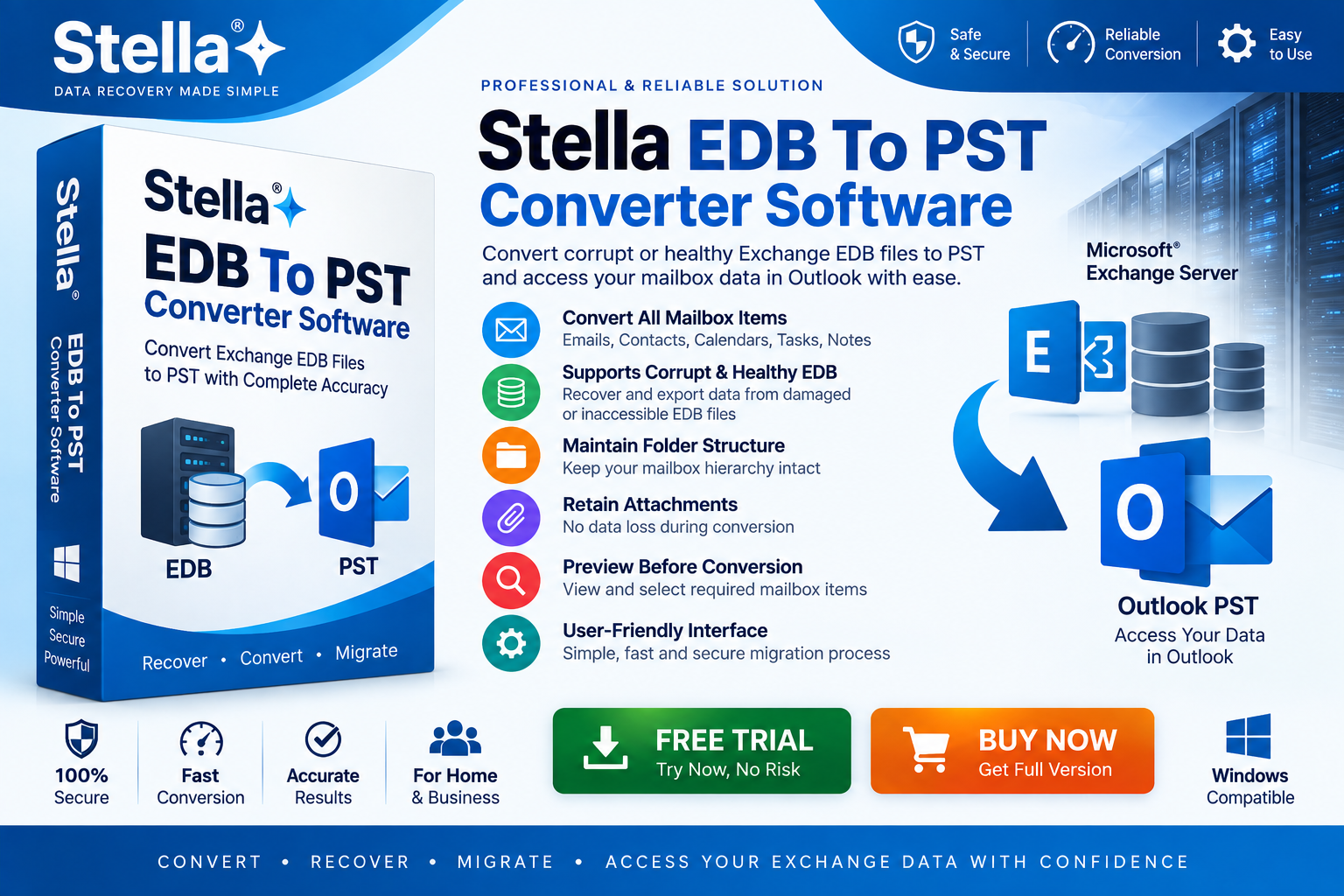
Converting EDB to PST is a common requirement when Exchange mailbox data needs to be migrated, recovered, archived, or accessed outside its original Exchange Server environment. EDB files store Exchange mailbox information, while PST files are commonly used to store Outlook mailbox data.
The challenge is that EDB and PST are completely different file formats. You cannot simply rename an .edb file to .pst and expect Outlook to open it. A proper conversion process must extract mailbox data from the EDB database and create a valid PST file.
In this guide, we will explain how to convert EDB to PST, including manual approaches, professional EDB-to-PST converter software, conversion of corrupt EDB files, important precautions, and verification steps.
What Is an EDB File?
EDB (Extensible Storage Engine Database) is a database file format associated with Microsoft Exchange Server. It can contain large amounts of mailbox information, including:
- Emails
- Attachments
- Contacts
- Calendars
- Tasks
- Notes
- Deleted items
- Custom mailbox folders
When Exchange Server is working normally, users generally access this information through their Exchange environment. However, when the server becomes unavailable or an organization needs to migrate historical data, administrators may need to extract information from an offline EDB file.
What Is a PST File?
PST (Personal Storage Table) is an Outlook data file used to store mailbox information locally.
A PST can contain:
- Email messages
- Attachments
- Contacts
- Calendars
- Tasks
- Notes
- Folder structures
Therefore, converting EDB to PST can provide a practical way to make Exchange mailbox information available in an Outlook-compatible format.
Can EDB Be Converted to PST?
Yes, EDB files can be converted to PST using appropriate Exchange migration or EDB-to-PST conversion software.
The exact method depends on your Exchange environment.
If the Exchange Server is functioning normally, administrators may have several migration/export options. If the EDB is offline and the original Exchange Server is unavailable, specialized EDB-to-PST software is often the more practical option.
The basic conversion workflow is:
EDB → Scan Database → Preview Mailbox Data → Select Data → Export to PST → Verify PST
Method 1: Convert EDB to PST Using Professional Software
For an offline EDB file, dedicated EDB to PST Converter Software can simplify the process.
These applications are designed to analyze Exchange database files and extract mailbox information into PST format.
Step 1: Create a Backup of the EDB
Before beginning the conversion, create a copy of the original EDB file.
For example:
Original EDB → Backup Copy → Conversion Copy
This is particularly important when working with business-critical or potentially corrupted databases.
Never make your only copy of an EDB the working copy.
Step 2: Install an EDB to PST Converter
Install a reputable EDB-to-PST conversion application on a compatible Windows system.
When selecting software, check whether it supports the EDB version you have and whether it provides useful features such as:
- Offline EDB processing
- Mailbox preview
- PST export
- Selective mailbox conversion
- Attachment extraction
- Folder hierarchy preservation
- Batch conversion
- Filtering
- Large EDB support
- Recovery from certain damaged databases
If available, use a trial version to test the software with your EDB before purchasing a full license.
Step 3: Add the EDB File
Open the converter and select the option to add or open an EDB file.
Browse to the location of the database and select it.
The application will typically analyze the database and identify available mailbox structures.
Depending on the size and condition of the database, scanning can take some time.
Step 4: Scan the EDB Database
Start the scanning process.
The software examines the EDB structure and attempts to identify available mailbox data.
For a healthy database, scanning may be relatively straightforward. If the database has corruption, the software may require additional processing to identify recoverable content.
The amount of data that can be recovered from a damaged EDB depends on the severity and nature of the corruption.
Step 5: Preview the Mailbox Data
A preview feature is extremely useful during EDB conversion.
After scanning, examine folders such as:
- Inbox
- Sent Items
- Drafts
- Deleted Items
- Contacts
- Calendar
- Tasks
- Custom folders
Open several messages and check whether their content and attachments appear correctly.
Why preview the data?
Because you should confirm that the required information is accessible before starting the final PST export.
Step 6: Select Mailboxes or Folders
If the EDB contains multiple mailboxes, you may not need to export everything.
Depending on the software, you may be able to select:
- Individual mailboxes
- Specific folders
- Selected emails
- Contacts
- Calendars
- Tasks
Selective conversion can make the process more efficient and reduce unnecessary PST data.
For example, if an administrator only needs the mailbox of one former employee, exporting the entire EDB may be unnecessary.
Step 7: Select PST as the Output Format
Choose PST as the export format.
Specify the destination location where the software should save the converted PST file.
If the application provides an option to preserve folder structure, enable it when maintaining the original mailbox hierarchy is important.
The conversion path is:
Exchange EDB → Outlook PST
Step 8: Start the Conversion
Start the export process.
The software will read the selected EDB mailbox data and create the corresponding PST file.
Avoid interrupting the application unnecessarily during the process.
For large databases, make sure the system has sufficient:
- Free storage
- RAM
- Processing capacity
- Temporary working space
The required working space can be considerably larger than the final PST size.
Step 9: Verify the PST File
Once the conversion finishes, do not immediately delete the original EDB.
First, verify the PST.
Check several folders and messages and confirm:
- Email content
- Attachments
- Sender and recipient details
- Dates
- Folder hierarchy
- Contacts
- Calendar items
- Tasks
- Important custom folders
Then open the PST in a compatible Outlook environment and verify representative data.
A successful conversion should not be judged only by whether a PST file was created. The actual mailbox contents must also be checked.
Method 2: Convert EDB to PST When Exchange Server Is Available
The approach can be different when the Exchange environment is still operational.
In a working Exchange environment, administrators can use supported Exchange/Outlook administration and export mechanisms appropriate to their Exchange version and organizational configuration.
This method may be preferable when:
- The Exchange Server is functioning correctly.
- Mailboxes are accessible.
- Administrative permissions are available.
- The goal is a normal mailbox migration or export.
However, this approach is different from recovering an offline EDB.
If the Exchange Server is no longer available, an offline EDB converter may be more appropriate.
How to Convert Corrupt EDB to PST
A damaged EDB creates an additional challenge.
Some specialized EDB recovery applications can extract mailbox data from certain corrupt databases, but recovery is not guaranteed.
The process generally involves:
Backup Corrupt EDB → Scan → Analyze Recoverable Data → Preview → Select Mailboxes → Export PST
The recovery result depends on:
- Severity of corruption
- Type of database damage
- Accessibility of the EDB
- Database structure
- Available recoverable pages
- Capabilities of the recovery software
For critical databases, always preserve the original file before attempting recovery.
Can You Convert EDB to PST Without Outlook?
It depends on the particular software.
Some dedicated EDB-to-PST applications can process an offline EDB and generate PST files without requiring the original Exchange Server or Outlook during the conversion stage.
However, creating a PST and opening a PST are two separate tasks.
Conversion: EDB data is extracted and written into PST.
Access: A compatible application is used to open or import the resulting PST.
Therefore, check the software’s system requirements before starting the project.
Can You Simply Rename EDB to PST?
No.
Changing:
database.edb
to:
database.pst
does not convert the database.
EDB and PST use different internal structures. The file extension tells an application what type of file it expects, but changing the extension does not transform the underlying database.
A genuine EDB-to-PST conversion requires specialized processing to extract the mailbox information and construct a valid PST.
Important Tips Before EDB to PST Conversion
1. Keep the original EDB
Always preserve the source database.
2. Work from a copy
Use a duplicate whenever possible, particularly for damaged files.
3. Check compatibility
Make sure the converter supports your Exchange EDB version.
4. Preview before export
Confirm that important mailbox data is readable.
5. Check attachments
Attachments can be business-critical, so verify them separately.
6. Maintain folder structure
If the original hierarchy matters, select a solution that supports folder preservation.
7. Ensure adequate storage
Large databases can require substantial temporary and destination storage.
8. Verify before deleting anything
Keep the EDB until the converted PST has been completely validated.
Why Use EDB to PST Converter Software?
For offline databases, specialized software can simplify a technically complex process.
A professional EDB to PST Converter Software may provide:
- Offline EDB scanning
- Mailbox preview
- Selective conversion
- Batch processing
- PST export
- Attachment extraction
- Folder structure preservation
- Filtering options
- Support for certain corrupt EDB files
These features can be particularly useful for IT administrators, Exchange migration specialists, data recovery professionals, and organizations handling legacy mailbox data.
Frequently Asked Questions
How do I convert EDB to PST?
Create a backup of the EDB, load it into suitable EDB-to-PST software, scan the database, preview the mailbox data, select the required mailboxes, choose PST as the output format, and export the data.
Can I convert EDB to PST without Exchange Server?
Yes. Specialized offline EDB-to-PST software can process an EDB file without requiring the original Exchange Server, depending on the product and database condition.
Can I convert a corrupt EDB to PST?
Some recovery tools can extract data from certain corrupt EDB files. However, the recovery outcome depends on the extent of database damage.
Does EDB-to-PST conversion preserve attachments?
Many professional conversion tools support attachment extraction. Always verify the converted PST before considering the migration complete.
Can I convert multiple mailboxes from an EDB?
Yes, if the selected software supports multiple-mailbox or batch conversion.
Is EDB the same as PST?
No. EDB is an Exchange database format, while PST is an Outlook data-file format. They have different structures and purposes.
Conclusion
EDB to PST conversion is useful when Exchange mailbox data needs to be migrated, recovered, archived, or accessed through Outlook. The right approach depends on whether the Exchange Server is operational or whether you only have an offline EDB file.
For an offline database, a dedicated EDB to PST Converter Software can provide a straightforward workflow:
Backup → Scan EDB → Preview → Select Mailboxes → Convert to PST → Verify
If the EDB is corrupt, choose a recovery-oriented solution and remember that successful recovery depends on the condition of the database.
Most importantly, never rely on simply changing the .edb extension to .pst. Use a genuine conversion process and thoroughly validate the resulting PST before retiring or deleting the original Exchange database.